Understanding collocations is crucial for achieving fluency in any language, and English is no exception. Collocations are pairs or groups of words that are frequently used together, giving language its natural flow. One common word that forms numerous collocations is “dead.” Despite its morbid connotation, “dead” appears in various everyday expressions that native speakers use frequently. In this blog post, we will explore 30 collocations with dead.
30 Powerful Collocations with Dead 😵 You Need to Know
Each entry will include a definition, phonetic transcription, and two example sentences to help you understand how to use these phrases in context. By mastering these collocations, you can enhance your English vocabulary, make your speech more natural, and avoid common mistakes that non-native speakers often make.
Whether you’re preparing for an English proficiency test or simply want to improve your conversational skills, this list of “dead” collocations is a must-read. Let’s dive in and discover how to use these expressions effectively!
#1. 🪦 Dead End
Definition: A situation or position with no potential for progress or advancement.
Phonetic Transcription: /dɛd ɛnd/
Examples:
- “The negotiations reached a dead end when neither party could agree on the terms.”
- “After following the trail for miles, they realized they had come to a dead end.”
#2. 💤 Dead Tired
Definition: Extremely tired or exhausted.
Phonetic Transcription: /dɛd taɪərd/
Examples:
- “After working a 12-hour shift, I was dead tired and just wanted to sleep.”
- “She was dead tired after the long journey and went straight to bed.”
#3. 🔇 Dead Silence
Definition: Complete and total silence.
Phonetic Transcription: /dɛd ˈsaɪləns/
Examples:
- “There was a dead silence in the room after the shocking announcement.”
- “The dead silence of the night was interrupted by a sudden loud noise.”
#4. 🌍 Dead Serious
Definition: Extremely serious or earnest.
Phonetic Transcription: /dɛd ˈsɪəriəs/
Examples:
- “He was dead serious when he said he would quit if the conditions didn’t improve.”
- “Don’t laugh, I’m dead serious about this decision.”
#5. ⚫ Dead Wrong
Definition: Completely incorrect or mistaken.
Phonetic Transcription: /dɛd rɔŋ/
Examples:
- “He was dead wrong about the weather; it rained all day.”
- “She realized she was dead wrong after seeing the actual results.”
#6. ❄️ Dead of Winter
Definition: The coldest part of winter.
Phonetic Transcription: /dɛd əv ˈwɪntər/
Examples:
- “They had to travel in the dead of winter, which made the journey even more challenging.”
- “The village looked hauntingly beautiful in the dead of winter.”
#7. 🛑 Dead Stop
Definition: A complete halt or stop.
Phonetic Transcription: /dɛd stɑp/
Examples:
- “The car came to a dead stop when the traffic light turned red.”
- “The meeting came to a dead stop when the fire alarm went off.”
#8. 🧘 Dead Calm
Definition: A state of complete stillness or calmness.
Phonetic Transcription: /dɛd kɑm/
Examples:
- “The ocean was dead calm after the storm passed.”
- “She remained dead calm even in the face of adversity.”
#9. 🕊️ Dead on Arrival
Definition: Used to describe something that is already ineffective or failed upon its arrival or introduction.
Phonetic Transcription: /dɛd ɒn əˈraɪvəl/
Examples:
- “The proposal was dead on arrival due to lack of support.”
- “The patient was declared dead on arrival at the hospital.”
#10. 🚫 Dead Weight
Definition: A heavy, burdensome load or person.
Phonetic Transcription: /dɛd weɪt/
Examples:
- “Carrying the injured player off the field was like carrying dead weight.”
- “He felt like a dead weight on the team, unable to contribute effectively.”
#11. 🔍 Dead Giveaway
Definition: Something that reveals the truth or gives away a secret.
Phonetic Transcription: /dɛd ˈɡɪvəˌweɪ/
Examples:
- “His nervous laughter was a dead giveaway that he was lying.”
- “The muddy footprints were a dead giveaway of who had been in the garden.”
#12. 🥀 Dead as a Doornail
Definition: Completely dead or lifeless.
Phonetic Transcription: /dɛd əz ə ˈdɔrnˌeɪl/
Examples:
- “The old battery is dead as a doornail; it won’t charge anymore.”
- “That idea is dead as a doornail; no one is interested.”
#13. 🛌 Dead Asleep
Definition: In a deep, undisturbed sleep.
Phonetic Transcription: /dɛd əˈslip/
Examples:
- “He was dead asleep and didn’t hear the phone ringing.”
- “After the long hike, they were all dead asleep within minutes.”
#14. 🪶 Dead Easy
Definition: Very easy, with no difficulty.
Phonetic Transcription: /dɛd ˈizi/
Examples:
- “The math test was dead easy; I finished it in no time.”
- “Cooking this recipe is dead easy, even for beginners.”
#15. 💀 Dead Body
Definition: A corpse or lifeless body.
Phonetic Transcription: /dɛd ˈbɑdi/
Examples:
- “The detective examined the dead body at the crime scene.”
- “They found a dead body in the abandoned building.”
#16. 💔 Dead Inside
Definition: Feeling emotionally numb or devoid of emotion.
Phonetic Transcription: /dɛd ɪnˈsaɪd/
Examples:
- “After the tragedy, he felt completely dead inside.”
- “She looked happy on the outside, but she felt dead inside.”
#17. 💬 Dead Language
Definition: A language that is no longer spoken as a native language.
Phonetic Transcription: /dɛd ˈlæŋɡwɪdʒ/
Examples:
- “Latin is considered a dead language, though it is still studied.”
- Ancient Greek is another example of a dead language.”
#18. 📅 Dead Last
Definition: Finishing in the very last position in a race or competition.
Phonetic Transcription: /dɛd læst/
Examples:
- “He finished dead last in the marathon, but he was proud to have completed it.”
- “Their team came in dead last in the competition.”
#19. 💢 Dead Certain
Definition: Absolutely certain or sure.
Phonetic Transcription: /dɛd ˈsɜrtən/
Examples:
- “I am dead certain that I locked the door before leaving.”
- “She was dead certain that she had seen him before.”
#20. 🧠 Dead Center
Definition: The exact middle point of something.
Phonetic Transcription: /dɛd ˈsɛntər/
Examples:
- “He aimed for the dead center of the target and hit it perfectly.”
- “The logo was placed dead center on the poster.”
#21. 🛠️ Dead Right
Definition: Completely correct or accurate.
Phonetic Transcription: /dɛd raɪt/
Examples:
- “You were dead right about the outcome of the election.”
- “The scientist’s prediction was dead right.”
#22. 🔥 Dead Heat
Definition: A race or competition in which two or more competitors finish in a tie.
Phonetic Transcription: /dɛd hit/
Examples:
- “The race ended in a dead heat with no clear winner.”
- “It was a dead heat between the two candidates in the election.”
#23. 😶 Deadpan
Definition: A deliberately expressionless or emotionless face or tone.
Phonetic Transcription: /dɛd pæn/
Examples:
- “He delivered the joke with a deadpan expression, making it even funnier.”
- “Her deadpan delivery confused everyone at first.”
#24. 😱 Dead Scared
Definition: Extremely frightened or terrified.
Phonetic Transcription: /dɛd skɛrd/
Examples:
- “She was dead scared of spiders and screamed when she saw one.”
- “He was dead scared about the surgery.”
#25. 🕓 Dead on Time
Definition: Exactly on time, neither early nor late.
Phonetic Transcription: /dɛd ɒn taɪm/
Examples:
- “The train arrived dead on time at the station.”
- “He completed the project dead on time, meeting the deadline.”
#26. 💡 Dead Simple
Definition: Very easy to understand or do.
Phonetic Transcription: /dɛd ˈsɪmpəl/
Examples:
- “The instructions were dead simple, even for beginners.”
- “Learning to use the new software was dead simple.”
#27. 🌙 Dead of Night
Definition: The middle of the night when it is darkest and quietest.
Phonetic Transcription: /dɛd əv naɪt/
Examples:
- “She woke up in the dead of night to a strange noise.”
- “The burglary occurred in the dead of night when everyone was asleep.”
#28. 🚷 Dead Zone
Definition: An area where something does not function or where there is no activity.
Phonetic Transcription: /dɛd zoʊn/
Examples:
- “There’s a dead zone in the house where the Wi-Fi doesn’t reach.”
- “The desert is often considered a dead zone due to the lack of life.”
#29. 😵 Dead Tired
Definition: Extremely tired or exhausted.
Phonetic Transcription: /dɛd taɪərd/
Examples:
- “He was dead tired after the long flight.”
- “After running the marathon, she felt dead tired.”
#30. ☠️ Dead Ringer
Definition: Someone or something that looks exactly like someone or something else.
Phonetic Transcription: /dɛd ˈrɪŋər/
Examples:
- “He’s a dead ringer for his father at the same age.”
- “The counterfeit watch was a dead ringer for the real thing.”
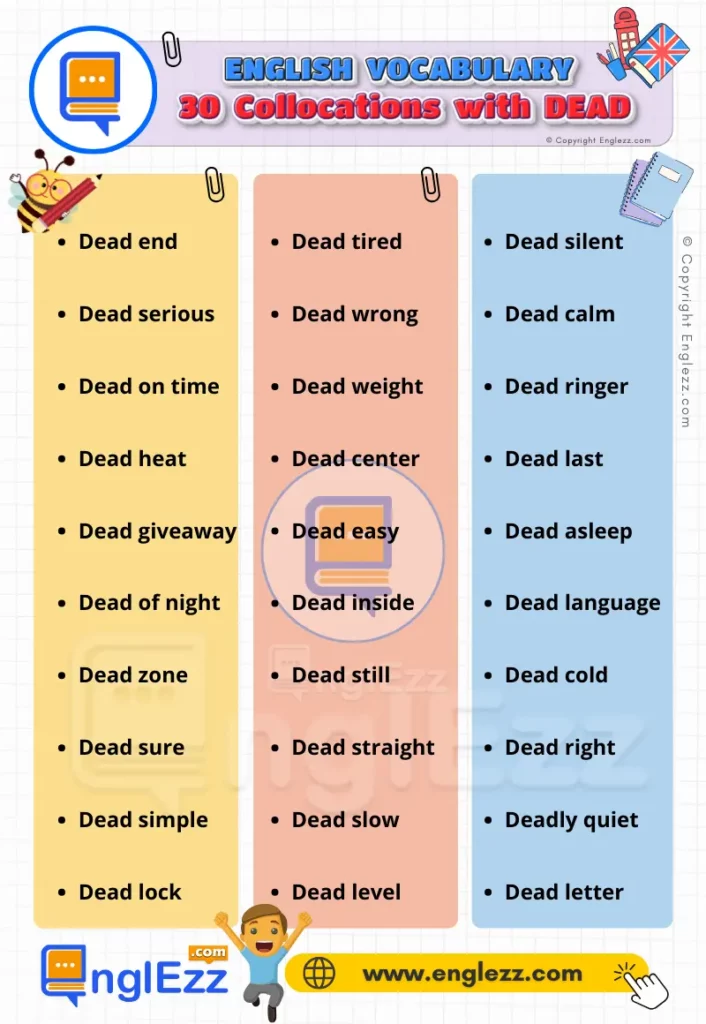
Collocations With DEAD Table
| Dead end | Dead tired | Dead silent |
| Dead serious | Dead wrong | Dead calm |
| Dead on time | Dead weight | Dead ringer |
| Dead heat | Dead center | Dead last |
| Dead giveaway | Dead easy | Dead asleep |
| Dead of night | Dead inside | Dead language |
| Dead zone | Dead still | Dead cold |
| Dead sure | Dead straight | Dead right |
| Dead simple | Dead slow | Deadly quiet |
| Dead lock | Dead level | Dead letter |
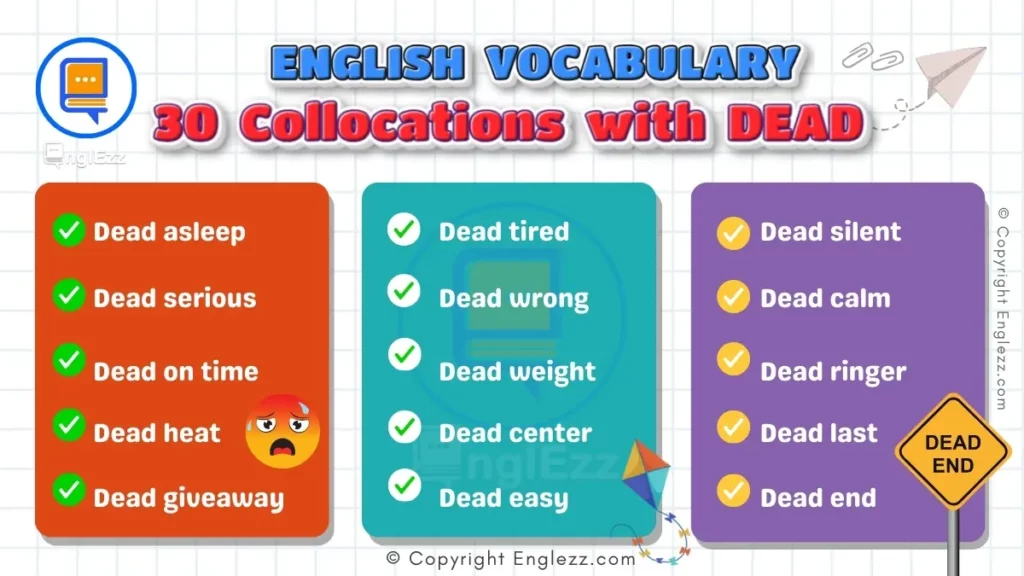
Most Common Collocations With DEAD Worksheet
Wrapping Up
Mastering collocations is an essential step in enhancing your English fluency. The 30 collocations with “dead” that we’ve explored in this blog post are phrases that you’ll frequently encounter in both spoken and written English. By familiarizing yourself with these expressions, you not only expand your vocabulary but also make your language more natural and idiomatic.
Remember, the key to mastering collocations is practice. Try using these “dead” collocations in your conversations, writing, and even thinking in English. The more you use them, the more natural they will become. Keep a list of these collocations handy and review them regularly to reinforce your learning.
Improving your English is a continuous journey, and mastering collocations is a significant milestone on that path. Stay curious, keep practicing, and soon you’ll find yourself using these expressions with confidence and ease. If you found this guide helpful, be sure to share it with others who are also looking to improve their English skills.
Happy learning! 😊